优化SMILE屈光结果:人工智能与传统先进列线图的比较
包含1342只眼睛数据,用于构建机器学习列线图以优化SMILE屈光结果预测的表格数据集。
基本信息
资源简介
优化SMILE屈光结果:人工智能与传统先进列线图的比较
【一句话概览】
本数据集是 figshare 公开的结构化表格数据集,收录 2 个文件、合计 25.50 MB,主题涵盖 Small incision lenticule extraction、SMILE、nomogram、artificial intelligence、machine learning,可用于统计建模、特征工程与队列分析,CC BY 4.0 许可开放获取。
【数据集背景】
本数据集源站标题为《Optimizing Refractive Outcomes of SMILE: Artificial Intelligence versus Conventional State-of-the-Art Nomograms》。配套论文《Optimizing Refractive Outcomes of SMILE: Artificial Intelligence versus Conventional State-of-the-Art Nomograms》发表于 Current Eye Research(2023),DOI:10.1080/02713683.2023.2282938。项目资助方:Jakob Siedlecki received previous speaker fees and travel expenses from Novartis Pharma GmbH, Carl Zeiss Meditec AG, Oculentis OSD Medical GmbH and Pharm-Allergan GmbH. Jakob Siedlecki received personal consultation fees from Bayer AG. Benedikt Schworm received previous speaker fees and travel expenses from Novartis Pharma GmbH and Topcon Corporation. Wolfgang Mayer received previous financial, consultation and speaker fee support from Carl Zeiss Meditec AG, Alcon Pharma GmbH, and Ziemer Ophthalmology GmbH. Wolfgang Mayer received previous financial and speaker fee support from Novartis Pharma GmbH, Oculentis OSD Medical GmbH, Pharm-Allergan GmbH and Bausch & Lomb GmbH. Wolfgang Mayer received previous speaker fees from Heidelberg Engineering GmbH, Oertli AG, and STAAR Surgical AG. Siegfried G. Priglinger received previous speaker fees and/or travel expenses from Novartis Pharma GmbH, Oertli AG, Bayer AG, Alcon Pharma GmbH and Pharm-Allergan GmbH. Nikolaus Luft received income from honoraria as a lecturer from Carl Zeiss Meditec AG, Alcon Laboratories Inc., NIDEK Co. Ltd and CenterVue SpA.。源站首次发布:2023-11-30。
【数据内容】
源站原始描述:AI (artificial intelligence)-based methodologies have become established tools for researchers and physicians in the entire field of ophthalmology. However, the potential of AI to optimize the refractive outcome of keratorefractive surgery by means of machine learning (ML)-based nomograms has not been exhausted yet. In this study, we wanted to comprehensively compare state-of-the-art conventional nomograms for Small-Incision-Lenticule-Extraction (SMILE) with a novel ML-based nomogram regarding b…
【数据结构与技术规格】
文件数 2 个,合计 25.50 MB。数据集 DOI:10.6084/m9.figshare.24679935.v1。
【主题与分类】
源站学科分类:Physiology、Biotechnology、Chemical Sciences not elsewhere classified、Biological Sciences not elsewhere classified、Cancer、Inorganic Chemistry。主题标签:Small incision lenticule extraction、SMILE、nomogram、artificial intelligence、machine learning。
【适用方向】
结构化表格数据可直接用于统计建模、特征工程与队列分析。
【获取与许可】
源站页面:https://tandf.figshare.com/articles/dataset/Optimizing_Refractive_Outcomes_of_SMILE_Artificial_Intelligence_versus_Conventional_State-of-the-Art_Nomograms/24679935
使用许可:CC BY 4.0(https://creativecommons.org/licenses/by/4.0/)。
规范引用:Optimizing Refractive Outcomes of SMILE: Artificial Intelligence versus Conventional State-of-the-Art Nomograms. Taylor & Francis. Luft, Nikolaus; Mohr, Niklas; Spiegel, Elmar; Marchi, Hannah; Siedlecki, Jakob; Harrant, Lisa; et al
【使用注意】
· 源站最后修改于 2024-02-23,引用时请注意版本时效。
下载信息
注册下载
需要注册 Kaggle 账号并登录后下载,适合需要跟踪下载记录和使用 API 的用户。
暂未开放公开下载
无需注册即可直接获取公开样本或文档,适合快速预览和评估数据集质量。
免登录有偿下载
公开数据集受托下载与技术交付服务。
提供高速下载与技术交付服务(收技术服务费,非数据销售)
暂未开放当前数据集主要来源为 Kaggle 公开托管,完整影像包建议通过原始链接或 Kaggle API 获取。
使用方式
数据集获取(Figshare)
- 源站标题:Optimizing Refractive Outcomes of SMILE: Artificial Intelligence versus Conventional State-of-the-Art Nomograms
- DOI:10.6084/m9.figshare.24679935.v1
- 发布日期:2023-11-30
- 文件数:2 个
- 文件总体积:25.50 MB
- 源站页面:https://tandf.figshare.com/articles/dataset/Optimizing_Refractive_Outcomes_of_SMILE_Artificial_Intelligence_versus_Conventional_State-of-the-Art_Nomograms/24679935
命令行下载
curl -L -o "ncer-2023-or-0280-File008.tiff" "https://ndownloader.figshare.com/files/43374153"
curl -L -o "ncer-2023-or-0280-File009.tiff" "https://ndownloader.figshare.com/files/43374156"
文件清单
ncer-2023-or-0280-File008.tiff(12.75 MB)ncer-2023-or-0280-File009.tiff(12.75 MB)
文件总体积 25.50 MB(源站 API 实测)。
数据加载示例(图像类)
from PIL import Image
import glob, os

files = (glob.glob(os.path.join(path, "**", "*.png"), recursive=True)
       + glob.glob(os.path.join(path, "**", "*.jpg"), recursive=True)
       + glob.glob(os.path.join(path, "**", "*.tif"), recursive=True))
print("图像文件数:", len(files))
img = Image.open(files[0]); print("尺寸/模式:", img.size, img.mode)

# torchvision Dataset 方式:
# from torchvision import datasets
# ds = datasets.ImageFolder(path)  # 要求 子目录=类别
目录组织与标注格式以源站说明和下载后实际文件为准。
数据说明
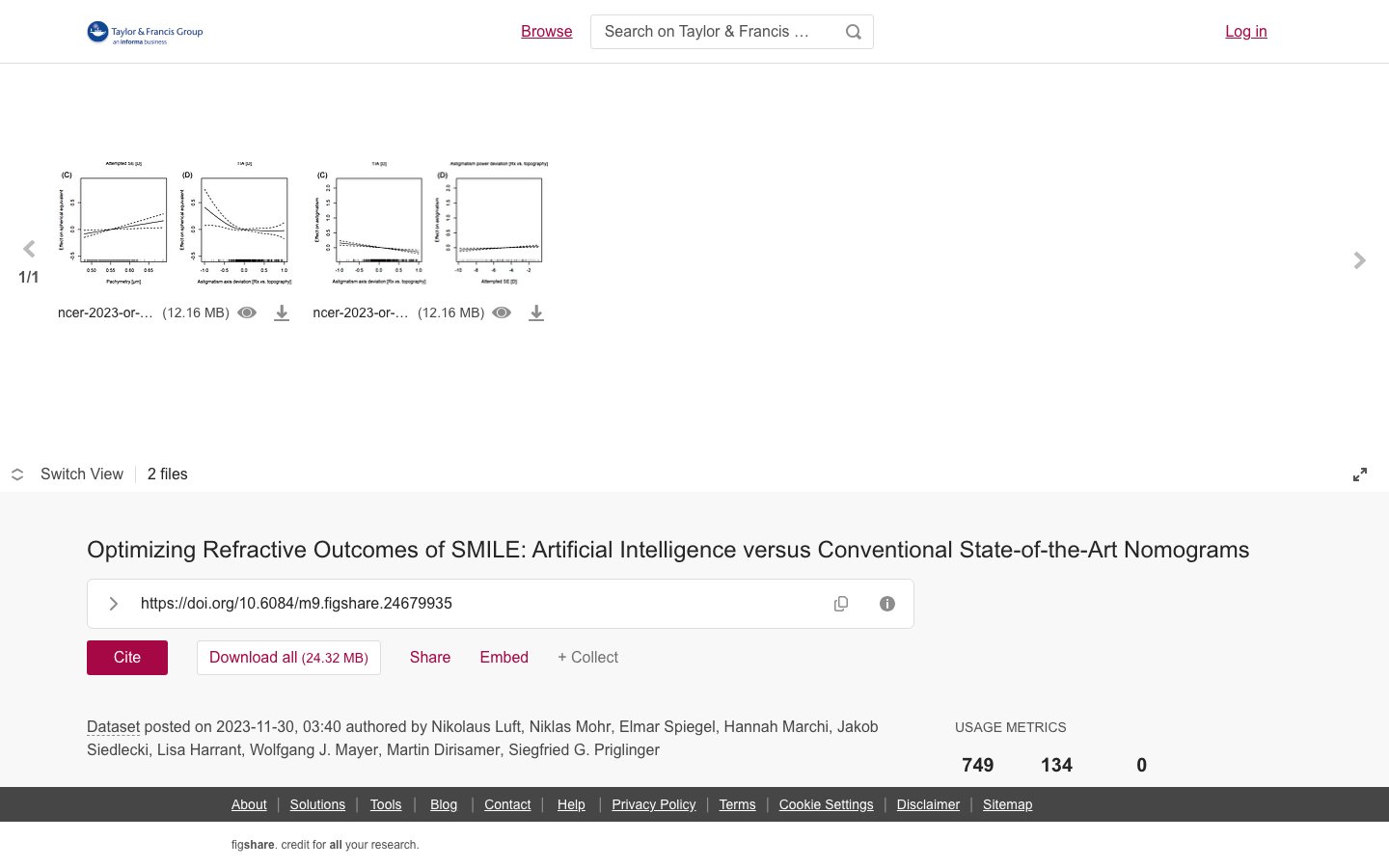
AI (artificial intelligence)-based methodologies have become established tools for researchers and physicians in the entire field of ophthalmology. However, the potential of AI to optimize the refractive outcome of keratorefractive surgery by means of machine learning (ML)-based nomograms has not been exhausted yet. In this study, we wanted to comprehensively compare state-of-the-art conventional nomograms for Small-Incision-Lenticule-Extraction (SMILE) with a novel ML-based nomogram regarding both their spherical and astigmatic predictability.
A total of 1,342 eyes were analyzed for creation of three different nomograms based on a linear model (LM), a generalized additive mixed model (GAMM) and an artificial-neuronal-network (ANN), respectively. A total of 16 patient- and treatment-related features were included. Each model was trained by 895 eyes and validated by the remaining 447 eyes. Predictability was assessed by the difference between attempted and achieved change in spherical equivalent (SE) and the difference between target induced astigmatism (TIA) and surgically induced astigmatism (SIA). The root mean squared error (RMSE) of each model was computed as a measure of overall model performance.
The RMSE of LM, GAMM and ANN were 0.355, 0.348 and 0.367 for the prediction of SE and 0.279, 0.278 and 0.290 for the astigmatic correction, respectively. By applying the created models, the theoretical yield of eyes within ±0.50 D of SE from target refraction improved from 82 to 83% (LM), 84% (GAMM) and 83% (ANN), respectively. Astigmatic outcomes showed an improvement of eyes within ±0.50 D from TIA from 90 to 93% (LM), 93% (GAMM) and 92% (ANN), respectively. Subjective manifest refraction was the single most influential covariate in all models.
Machine learning endorsed the validity of state-of-the-art linear and non-linear SMILE nomograms. However, improving the accuracy of subjective manifest refraction seems warranted for optimizing ±0.50 D SE predictability beyond an apparent methodological 90% limit.
许可
CC BY 4.0
引用
学术使用请引用 DOI 10.6084/m9.figshare.24679935.v1(source: https://tandf.figshare.com/articles/dataset/Optimizing_Refractive_Outcomes_of_SMILE_Artificial_Intelligence_versus_Conventional_State-of-the-Art_Nomograms/24679935)。
数据缺失?
依托陕西、四川两大基地,我们与超过十家三甲医院建立直接合作关系,覆盖合规授权、采集治理、专业标注、数据交付的全流程,为AI医疗团队提供即拿即用的高质量临床数据。
⚡️ 需要数据支持或标注服务?立即联系我们获取专业方案。