对解释的忠实度
评估ChatGPT4等大语言模型在口腔颌面外科问答生成能力的文本数据集,含150个问题及答案。

基本信息
资源简介
对解释的忠实度
【一句话概览】
本数据集是 figshare 公开的文本数据集,收录 1 个文件、合计 5.63 KB,主题涵盖 results also emphasize、highlighting persistent challenges、contextual understanding gaps、llms like chatgpt4、large language models,可用于医学自然语言处理(实体识别、信息抽取等),CC BY 4.0 许可开放获取。
【数据集背景】
本数据集源站标题为《degree of faithfulness to the explanation.》。源站首次发布:2025-05-28。
【数据内容】
源站原始描述:Introduction In this study, we aim to evaluate the ability of large language models (LLM) to generate questions and answers in oral and maxillofacial surgery. Methods ChatGPT4, ChatGPT4o, and Claude3-Opus were evaluated in this study. Each LLM was instructed to generate 50 questions about oral and maxillofacial surgery. Three LLMs were asked to answer the generated 150 questions. Results All 150 questions generated by the three LLMs were related to oral and maxillofacial surgery. Each model exhi…
中文译文(机器翻译,仅供快速理解,请以原文为准):引言 本研究旨在评估大语言模型(LLM)在口腔颌面外科领域生成问题与答案的能力。 方法 本研究评估了ChatGPT4、ChatGPT4o和Claude3-Opus。每个LLM被要求生成50个关于口腔颌面外科的问题。随后,三个LLM被要求回答所生成的150个问题。 结果 三个LLM生成的全部150个问题均与口腔颌面外科相关。每个模型的正确答案率均超过90%。三个模型均未能正确回答其自身生成的所有问题。含图问题的正确答案率为97.0%,显著高于不含图问题的88.9%。对三个LLM解题情况的分析显示,每个模型通常都能以较高准确度推断答案,且鲜有可被认为存在争议的逻辑错误。此外,三个模型对其解释的保真度评分均高于88%。 结论 本研究表明,尽管ChatGPT4、ChatGPT4o和Claude3-Opus等LLM在生成和解答口腔颌面外科问题方面表现出强大能力,但其性能并非没有局限。没有一个模型能够正确回答其自身生成的所有问题,这凸显了AI幻觉和语境理解差距等持续存在的挑战。结果还强调了多模态输入的重要性,因为带有标注图像的问题相比纯文本提示取得了更高的准确率。尽管存在这些不足,LLM在问题解决、逻辑一致性和回答保真度方面仍展现出显著潜力,尤其是在结构化或数值情境中。
【数据结构与技术规格】
文件数 1 个,合计 5.63 KB。Table 5.xls:application/vnd.ms-excel,5.63 KB。数据集 DOI:10.1371/journal.pone.0322529.t005。
【主题与分类】
源站学科分类:Genetics、Molecular Biology、Neuroscience、Biotechnology、Developmental Biology、Science Policy。主题标签:results also emphasize、highlighting persistent challenges、contextual understanding gaps、llms like chatgpt4、large language models、generate 50 questions、three llms showed、maxillofacial surgery questions、150 questions generated、questions without figures。
【适用方向】
文本类数据可用于医学自然语言处理,如命名实体识别、信息抽取与文本分类。
【获取与许可】
源站页面:https://plos.figshare.com/articles/dataset/degree_of_faithfulness_to_the_explanation_/29173305
使用许可:CC BY 4.0(https://creativecommons.org/licenses/by/4.0/)。
规范引用:Kim, Kyuhyung; Mun, Sae Byeol; Kim, Young Jae; Kim, Bong Chul; Kim, Kwang Gi (2025). degree of faithfulness to the explanation.. PLOS ONE. Dataset
下载信息
注册下载
需要注册 Kaggle 账号并登录后下载,适合需要跟踪下载记录和使用 API 的用户。
暂未开放公开下载
无需注册即可直接获取公开样本或文档,适合快速预览和评估数据集质量。
免登录有偿下载
公开数据集受托下载与技术交付服务。
提供高速下载与技术交付服务(收技术服务费,非数据销售)
暂未开放当前数据集主要来源为 Kaggle 公开托管,完整影像包建议通过原始链接或 Kaggle API 获取。
使用方式
数据集获取(Figshare)
- 源站标题:degree of faithfulness to the explanation.
- DOI:10.1371/journal.pone.0322529.t005
- 发布日期:2025-05-28
- 文件数:1 个
- 文件总体积:5.63 KB
- 源站页面:https://plos.figshare.com/articles/dataset/degree_of_faithfulness_to_the_explanation_/29173305
命令行下载
curl -L -o "Table 5.xls" "https://ndownloader.figshare.com/files/54900252"
文件清单
Table 5.xls(5.63 KB)
文件总体积 5.63 KB(源站 API 实测)。
数据加载示例(图像类)
from PIL import Image
import glob, os

files = (glob.glob(os.path.join(path, "**", "*.png"), recursive=True)
       + glob.glob(os.path.join(path, "**", "*.jpg"), recursive=True)
       + glob.glob(os.path.join(path, "**", "*.tif"), recursive=True))
print("图像文件数:", len(files))
img = Image.open(files[0]); print("尺寸/模式:", img.size, img.mode)

# torchvision Dataset 方式:
# from torchvision import datasets
# ds = datasets.ImageFolder(path)  # 要求 子目录=类别
目录组织与标注格式以源站说明和下载后实际文件为准。
数据说明
Introduction
In this study, we aim to evaluate the ability of large language models (LLM) to generate questions and answers in oral and maxillofacial surgery.
Methods
ChatGPT4, ChatGPT4o, and Claude3-Opus were evaluated in this study. Each LLM was instructed to generate 50 questions about oral and maxillofacial surgery. Three LLMs were asked to answer the generated 150 questions.
Results
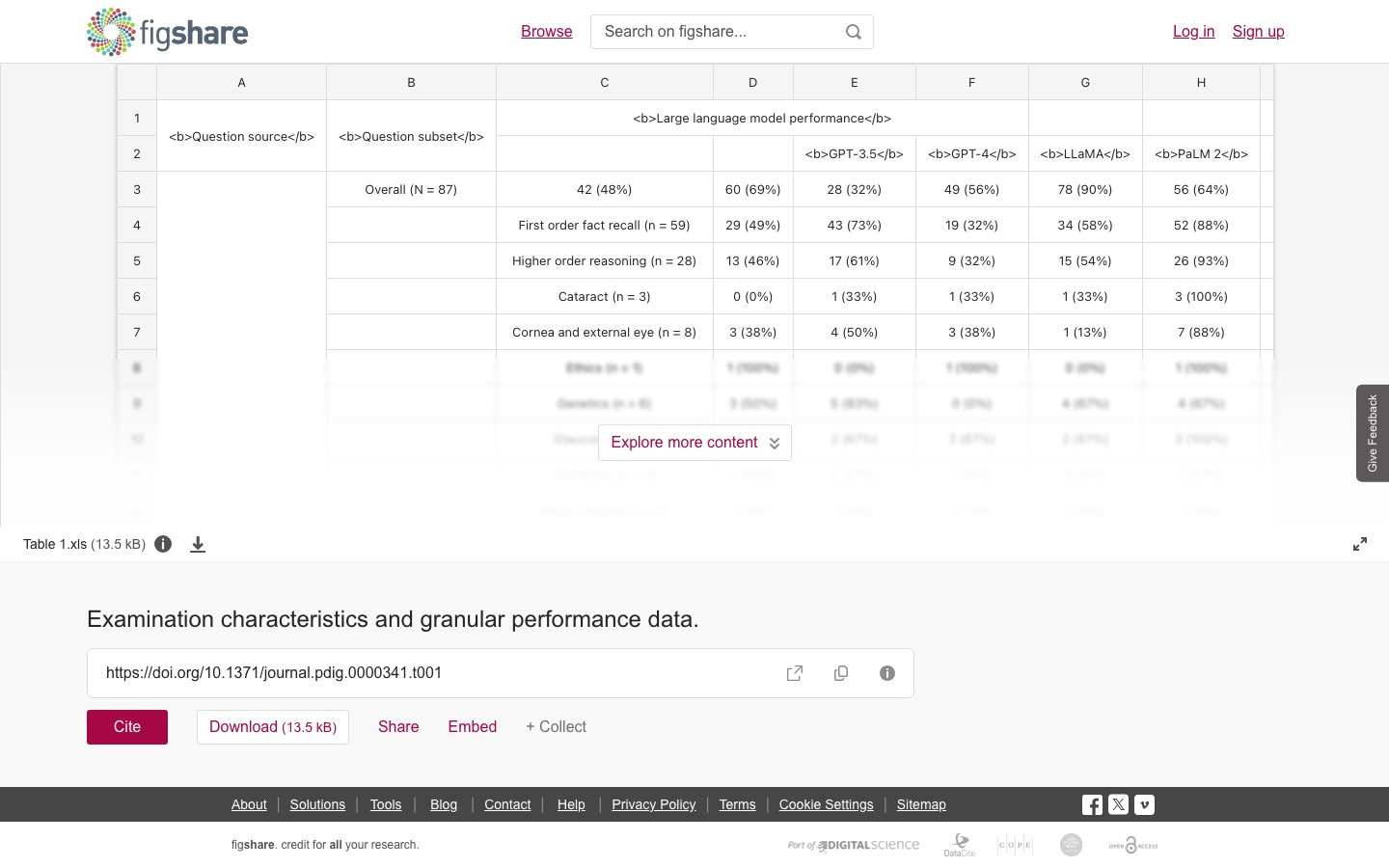
All 150 questions generated by the three LLMs were related to oral and maxillofacial surgery. Each model exhibited a correct answer rate of over 90%. None of the three models were able to answer correctly all the questions they generated themselves. The correct answer rate was 97.0% for questions with figures, significantly higher than the 88.9% rate for questions without figures. The analysis of problem-solving by the three LLMs showed that each model generally inferred answers with high accuracy, and there were few logical errors that could be considered controversial. Additionally, all three scored above 88% for the fidelity of their explanations.
Conclusion
This study demonstrates that while LLMs like ChatGPT4, ChatGPT4o, and Claude3-Opus exhibit robust capabilities in generating and solving oral and maxillofacial surgery questions, their performance is not without limitations. None of the models were able to answer correctly all the questions they generated themselves, highlighting persistent challenges such as AI hallucinations and contextual understanding gaps. The results also emphasize the importance of multimodal inputs, as questions with annotated images achieved higher accuracy rates compared to text-only prompts. Despite these shortcomings, the LLMs showed significant promise in problem-solving, logical consistency, and response fidelity, particularly in structured or numerical contexts.
许可
CC BY 4.0
引用
学术使用请引用 DOI 10.1371/journal.pone.0322529.t005(source: https://plos.figshare.com/articles/dataset/degree_of_faithfulness_to_the_explanation_/29173305)。
数据缺失?
依托陕西、四川两大基地,我们与超过十家三甲医院建立直接合作关系,覆盖合规授权、采集治理、专业标注、数据交付的全流程,为AI医疗团队提供即拿即用的高质量临床数据。
⚡️ 需要数据支持或标注服务?立即联系我们获取专业方案。