PRJNA722927: Novel Cellular Patterns and Gene Drivers of Relapse in Adult Acute Myelogenous Leukemia
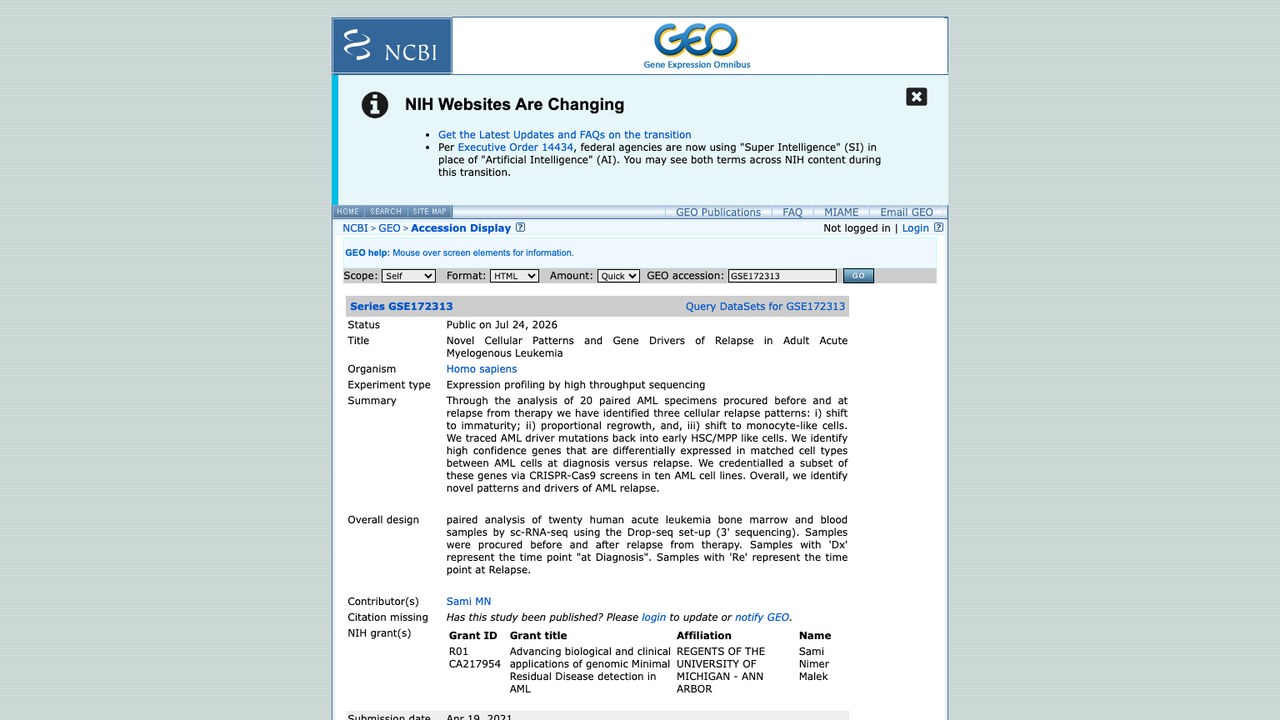
PRJNA722927: Novel Cellular Patterns and Gene Drivers of Relapse in Adult Acute Myelogenous Leukemia [Content] Through the analysis of 20 paired AML specimens procured before and at relapse from therapy we have identified three cellular relapse patterns: i) shift to immaturity; ii) proportional regrowth, and, iii) shift to monocyte-like cells. We traced AML driver mutations back into early HSC/MPP like cells. We identify high confidence genes that are differentially expressed in matched cell types between AML cells at diagnosis versus relapse. We credentialled a subset of these genes via CRISPR-Cas9 screens in ten AML cell lines. Overall, we identify novel patterns and drivers of AML relapse. [Topics] Tags: Transcriptome or Gene expression. [Access and licence] Source page: https://ncbi.nlm.nih.gov/bioproject/PRJNA722927
Basic Info
About
PRJNA722927: Novel Cellular Patterns and Gene Drivers of Relapse in Adult Acute Myelogenous Leukemia
[Content]
Through the analysis of 20 paired AML specimens procured before and at relapse from therapy we have identified three cellular relapse patterns: i) shift to immaturity; ii) proportional regrowth, and, iii) shift to monocyte-like cells. We traced AML driver mutations back into early HSC/MPP like cells. We identify high confidence genes that are differentially expressed in matched cell types between AML cells at diagnosis versus relapse. We credentialled a subset of these genes via CRISPR-Cas9 screens in ten AML cell lines. Overall, we identify novel patterns and drivers of AML relapse.
[Topics]
Tags: Transcriptome or Gene expression.
[Access and licence]
Source page: https://ncbi.nlm.nih.gov/bioproject/PRJNA722927
Official Service
Dual Bases in Shaanxi & Sichuan × Direct Access to 10+ Grade-A Tertiary Hospitals
From compliant authorization and collection governance to professional annotation and dataset delivery, we provide a closed-loop, end-to-end service that makes high-quality clinical data ready to use.
⚡️ Need raw data or annotation support? Contact us for a custom solution.
Download
注册下载
Requires a Kaggle account and sign-in to download — suited for users who need to track download history or use the API.
Unavailable公开下载
No registration needed — directly access public samples or documents, ideal for quickly previewing and evaluating dataset quality.
免登录有偿下载
Entrusted download and technical delivery service for public datasets.
提供高速下载与技术交付服务(收技术服务费,非数据销售)
UnavailableThis dataset is primarily hosted publicly on Kaggle. For the complete image package, use the source link or the Kaggle API.
Usage
数据集获取
源站:https://ncbi.nlm.nih.gov/bioproject/PRJNA722927
标准获取流程:
- 访问源站链接,注册/登录账号;
- 进入数据集详情页,按页面指引申请权限或直接下载;
- 部分平台提供 SDK,例如:
- OpenDataLab:
pip install openxlab后openxlab.dataset.get(...) - ModelScope:
pip install modelscope后modelscope download - 天池: 登录后页面提供直链下载
以源站「数据下载/使用文档」页面为准。
- OpenDataLab:
数据说明
通过对20对治疗前和复发时采集的配对AML标本进行分析,我们识别出三种细胞复发模式:i)向未成熟状态转变;ii)比例性再生长;iii)向单核细胞样细胞转变。我们将AML驱动突变追溯至早期HSC/MPP样细胞。我们鉴定出在诊断时与复发时的AML细胞之间,匹配细胞类型中差异表达的高置信度基因。我们通过CRISPR-Cas9筛选在十种AML细胞系中对其中一部分基因进行了验证。总体而言,我们识别出AML复发的新模式及驱动因素。
Data Gaps?
Backed by our bases in Shaanxi and Sichuan, we partner directly with over ten Grade-A tertiary hospitals, covering the full pipeline of compliant authorization, data collection and governance, professional annotation, and delivery — providing AI medical teams with ready-to-use, high-quality clinical data.
⚡️ Need data support or annotation services? Contact us now for a professional solution.